Tales of the Republic Universe
Tales of the Republic is a sweeping post-collapse saga about nations falling, ordinary people rising, and the desperate struggle to decide what deserves to survive when the old world is gone.
The story begins in a world already coming apart.
Governments grow distant from the people they rule. International powers tighten their grip. Communities are divided, resources become weapons, and once-proud nations surrender pieces of themselves in exchange for promises of security and peace. In the forgotten towns, farms, mountains, and back roads, however, people begin to resist.
From the hills of Kentucky to the battlefields of Europe, Russia, and beyond, Tales of the Republic follows soldiers, families, rebels, survivors, politicians, believers, and broken men and women caught inside the collapse of an age.
Some fight for their homes.
Some fight for power.
Some simply fight to see another sunrise.
The rise of the Founders and their war against the United Nations marks only the beginning. Across the world, the United Collective Nations emerges as a new power while old alliances fracture and entire countries disappear beneath the weight of war. Then humanity faces something far worse than armies or governments: an Infection capable of turning civilization's survivors against one another and bringing what remains of the modern world to its knees.
When communications fail, armies vanish, borders become meaningless, and the great institutions of mankind fall silent, survival returns to something ancient.
Family.
Faith.
Land.
Loyalty.
And the willingness to stand beside another human being when there is no one left coming to save you.
Yet Tales of the Republic is not merely the story of the end of civilization. It is the story of what comes afterward.
Decades may pass. Flags may change. Heroes may become legends, villains may become warnings, and children may inherit a world they never broke. Across generations, scattered people will attempt to rebuild communities, restore order, rediscover lost truths, and determine whether a republic can rise again from the ashes—or whether mankind will simply repeat the mistakes that destroyed the old world.
Every battlefield, every forgotten settlement, every abandoned road, and every survivor carries another piece of the story.
These are their stories.
These are the Tales of the Republic.
The UCN
The United Collective Nations
A Historian’s Account from the Tales of the Republic Universe
The United Collective Nations did not rise out of one war, one treaty, or one man’s ambition. It came from a world that had been weakening for decades, a world where nations had become tied together so tightly that no one could tell where one country’s survival ended and another country’s dependency began. Food crossed oceans before it reached tables. Factories stood in one nation while the workers who depended on their products lived in another. Energy, medicine, grain, steel, computer systems, debt, and military supply chains all became part of a web too large for any single government to fully control.
The UCN looked at that broken web and offered an answer that sounded harsh, but to many frightened nations also sounded practical. It argued that mankind’s greatest danger was not famine, disease, or even war. Those things, according to the Collective, were only symptoms of something older and deeper. The true sickness was division. Different flags, different laws, different loyalties, different histories, and different ideas of freedom had kept mankind fighting itself since the first cities rose out of mud and stone.
That belief became the heart of the UCN. Order was placed above liberty. Duty was placed above individuality. The collective was placed above the self. Supporters called this maturity, the moment mankind finally outgrew the selfish chaos of old nation-states. Critics called it the death of the human soul wrapped in the language of survival.
The nations that joined the UCN did not vanish from maps. Russia remained Russia. China remained China. Germany, France, Belarus, Kazakhstan, Latvia, Lithuania, Estonia, Armenia, Kyrgyzstan, Tajikistan, and others still had names, flags, capitals, histories, and people who remembered what they had been before. But political independence slowly became more appearance than reality. Each agreement surrendered a little more control. Economic coordination became shared production. Shared production became centralized planning. Regional defense became unified military command. Standardized law became common authority. What had begun as cooperation became a system.
To understand why so many accepted it, one must remember the fear of the age. The United Nations had grown into a power of its own, and many countries no longer trusted its claims of neutrality. After NATO was absorbed into the UN, Russia and its allies believed the old enemy had not disappeared, but had simply changed uniforms. The blue flag of the UN did not look peaceful to Moscow. It looked like NATO wearing better language and broader legal authority.
That suspicion deepened as unexplained disasters struck nations that resisted UN influence. Rail lines were damaged in key regions. Pipelines burned at the worst possible times. Border villages reported poisoned wells. Industrial sites suffered accidents that seemed too precise to be chance. Proxy groups appeared with weapons they should not have possessed. In several cases, depleted uranium munitions were allegedly used by forces the UN denied controlling, leaving land and water damaged long after the fighting had passed.
The UN denied involvement in every case, blaming separatists, criminals, unstable governments, old ethnic rivalries, or environmental failure. Yet to Russia, Iran, and others watching from the outside, the pattern was too clear to ignore. First came pressure, then sanctions, then unrest, then sabotage, then humanitarian concern, and then peacekeepers or advisers arriving to manage the crisis. The UN called this stabilization. Russia called it strangulation.
The United Collective Nations grew from that distrust. It was not merely an ideological project. It was also a defensive reaction against what many nations believed was a slow UN empire spreading through treaties, sanctions, proxy warfare, and peacekeeping occupation. Russia brought military strength, natural resources, and old suspicion. China brought manufacturing power, population, and industrial reach. Germany and France brought technology, engineering, and influence. The Eastern European and Central Asian states brought territory, manpower, resources, and strategic depth. Together they formed something greater than an alliance, but not quite an empire in the old sense. They became a machine made of nations.
Inside that machine, the individual had value only when tied to purpose. A worker mattered because production mattered. A soldier mattered because the mission mattered. A scientist mattered because progress mattered. A family mattered when it strengthened loyalty to the Collective. Faith, culture, tradition, and local identity were tolerated only when they did not challenge the larger system. The UCN did not always erase the old world at once. More often, it absorbed it, renamed it, and made it serve.
The government of the UCN reflected this belief. Regional governors managed territory. Military administrators enforced order. Political commissars watched loyalty. Industrial boards directed labor and production. Scientific councils shaped research and development. Food, medicine, weapons, transportation, fuel, education, and information all moved through layers of centralized authority. The system was not designed to ask people what they wanted. It was designed to decide what was needed and make everyone serve that decision.
To its supporters, this was strength. They saw no virtue in endless debate while nations starved and borders burned. They believed elections had become theater, freedom had become selfishness, and old governments had become too weak to solve modern problems. The Collective offered certainty where democracy offered argument. It offered bread, work, power, security, and direction. For people who had watched their old countries fail, those promises carried weight.
To its enemies, the UCN was one of the most efficient cages ever built. It did not always need terror in the streets because it had organization in every office. It did not need to burn every church because it could license them, monitor them, and slowly starve out any teaching that placed God, conscience, or family above the state. It did not need to destroy every family because it could teach children that loyalty to the Collective stood higher than loyalty to blood.
The UCN military became the clearest expression of the system’s soul. It was not built around individual glory. It was built around logistics, discipline, numbers, planning, and sacrifice. A battle was not judged by how many men survived, but by whether the objective was secured at an acceptable cost. Western commanders had once spoken of minimizing casualties. UCN commanders spoke of expenditure, replacement, supply, and outcome. The soldier was respected, but never allowed to become greater than the mission.
This did not mean courage was absent. UCN soldiers could be brave, disciplined, loyal, and hard beyond measure. Many believed deeply in what they served. Many saw themselves as the wall standing between mankind and chaos. But even courage belonged to the Collective. A man who died for the mission was honored. A man who died for personal glory had wasted himself. In the UCN, even sacrifice had to be useful.
Science held a place nearly equal to the military, and in some regions perhaps greater. Research was judged less by moral restraint and more by result. If a discovery strengthened soldiers, increased food production, improved obedience, extended survival, or weakened an enemy, then the work was considered justified. Experiments that other governments would have condemned were defended as necessary to protect millions. The suffering of a few, they argued, could not outweigh the survival of the many.
That word appeared again and again in UCN records: necessary. Necessary relocation. Necessary labor. Necessary correction. Necessary sacrifice. Necessary research. Necessary unity. It became the word that excused everything. Once a government convinces itself that morality is measured only by usefulness, there is very little it cannot justify.
Yet a fair historian must admit that the UCN was not powerless because people hated it. It was powerful because many people believed in it. It gave structure to broken nations. It gave hungry families food. It gave workers employment. It gave soldiers purpose. It gave frightened citizens the feeling that their suffering had meaning. In a world where the UN spoke softly while tightening its grip, the UCN’s hard honesty seemed almost cleaner to those already disillusioned.
That was the terrible choice many nations believed they faced. The United Nations offered peace through management, ration cards, Harmony Zones, international law, and blue-helmeted order. The United Collective Nations offered unity through discipline, production, sacrifice, and the strength of the whole. One wore control like mercy. The other wore control like armor. Both claimed they were saving mankind. Both demanded obedience as the price.
The Last Great War was therefore more than a struggle between armies. It was a war between systems that had both lost faith in ordinary people. The UN believed freedom had to be managed for the sake of peace. The UCN believed freedom had to be surrendered for the sake of unity. Neither trusted families, churches, towns, or local memory to govern themselves. Both believed history had proven the common man too divided and too dangerous to remain free.
That was their shared blindness. A UCN governor could measure grain output, fuel consumption, troop strength, labor efficiency, and civilian compliance. A commissar could record disloyal words and send reports up the chain. A scientific council could measure infection rates, endurance, obedience, and fear response. But none of them could measure the moment when a father decided the system would not have his son. None of them could measure a mother whispering an old prayer after the state had told her faith was obsolete. None of them could measure the weight of a family name carried across generations.
The UCN believed mankind could be rebuilt if every part was forced into its proper place. It believed nations could become limbs of a greater body, people could become instruments of a greater purpose, and sacrifice could wash away the weakness of the old world. For a time, it seemed possible. The Collective moved armies, fed cities, rebuilt industry, crushed uprisings, and stood against the UN with a strength few powers in history had ever matched.
But people are not steel. They are not rail lines, factories, or numbers in a supply report. They remember. They grieve. They love. They bury their dead and tell stories over the graves. They pass down truth when schools rewrite books and officials rename crimes as policy. That is the danger every system of control eventually faces. Somewhere beneath the banners, someone remembers he was born free.
The United Collective Nations may be remembered by some as history’s greatest unifier, the power that disciplined broken nations and stood against the expanding reach of the UN. Others will remember it as an iron cage, efficient, organized, and strong enough to make slavery look like survival.
Both memories hold pieces of the truth. The UCN did bring order. It brought strength. It brought unity. It gave frightened nations a shield against the soft empire of the UN. But it also proved one of history’s oldest warnings: peace without freedom is only quiet obedience, and a nation that gives up its soul to survive may wake one day and find survival was the smallest thing it lost.
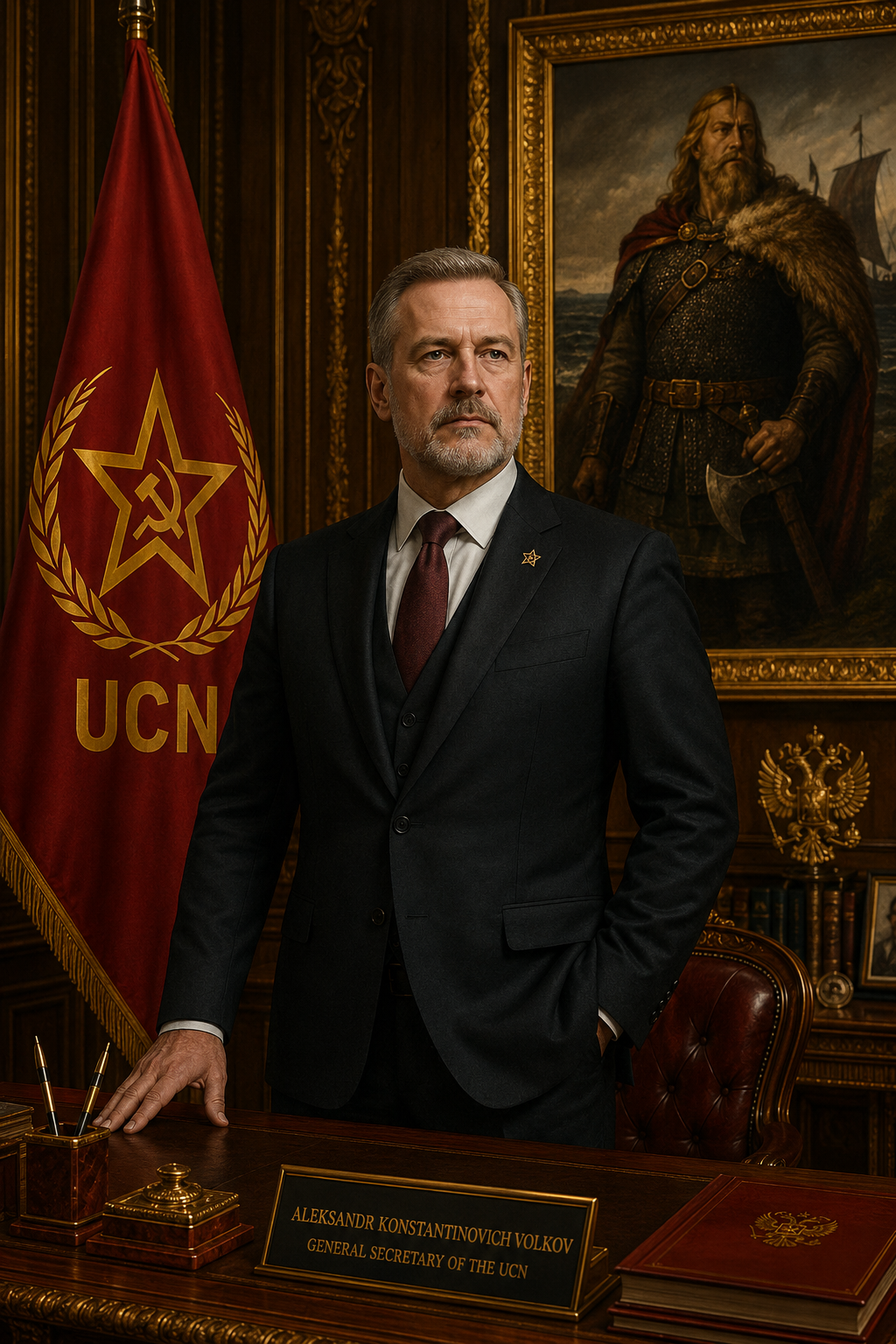
Aleksandr Konstantinovich Volkov
From The Rise of the United Collective Nations: A History of the New Order
Historians still disagree on the exact moment the United Collective Nations truly began. Some point to the first economic agreements between Russia and China, others to the military cooperation that followed, and there are those who argue the UCN did not really exist until several nations openly refused to obey sanctions imposed through the old United Nations system. In Russia, however, the answer has always been simpler. The UCN began with Aleksandr Konstantinovich Volkov, because before there was a charter, a flag, or a collective military command, there was a man who convinced Russians that their country no longer had to accept being treated as something lesser.
Volkov rose during a period when relations between Russia and the UN-aligned powers had deteriorated beyond the normal arguments between governments. Sanctions had become common, Russian companies were restricted from markets they had helped supply, and foreign politicians regularly spoke about the country as though its only importance came from oil, natural gas, minerals, and nuclear weapons. Russia was expected to provide resources when those resources were needed, but when Russian leaders acted in ways that conflicted with the interests of the UN powers, the country was treated as backward, dangerous, or undeserving of the same freedom of action those governments claimed for themselves.
Volkov understood how deeply that attitude angered ordinary Russians, because he shared the anger himself. He did not believe Russia needed approval from London, Washington, Paris, Brussels, or the United Nations to justify its existence or protect its interests. He believed a sovereign nation was sovereign because it possessed the strength to defend its people, feed them, keep its factories operating, protect its borders, and refuse demands that worked against its future. A country dependent upon another nation for those things might still have a flag and an anthem, but Volkov argued that dependency eventually became obedience.
He was not remembered as a loud man. People who met him described someone who listened more than he spoke and rarely wasted words trying to impress a room. He did not need to shout to appear angry, and when challenged publicly he usually answered with the same measured tone he used when discussing ordinary government business. That calmness became part of his reputation, particularly after a Western official mocked Russia as little more than a gas station pretending to be a great power.
Volkov answered during an address in Moscow.
“They believed Russia existed to supply them. They mistook restraint for dependence. They will not make that mistake again.”
The sentence spread through Russia faster than anyone in his government expected. Workers painted versions of it inside factories, soldiers repeated it in barracks, and commentators used it whenever another dispute erupted with the UN. It became popular because Volkov had put into one sentence what many Russians believed had been happening for years. Their country had been treated as useful when others needed something from it, but dangerous whenever it demanded to be treated as an equal.
Volkov's answer was not to ask for that equality more politely. He began reducing Russia's dependence on the people he believed would always use it against them. Domestic manufacturing received heavy investment, military production expanded, and agriculture increasingly became a matter of national security rather than simply economics. Russia began redirecting energy and trade toward countries willing to deal with it without attaching political obedience to every agreement, while industries considered vital to national survival were encouraged to replace foreign components wherever possible.
The military underwent the same change. Volkov had little patience for equipment that existed only for parades or military formations that looked impressive on paper but could not survive a real war. Readiness became something commanders were expected to prove rather than claim, and officers learned quickly that Volkov had a habit of asking questions that exposed the difference between the two.
One story from an early inspection became famous throughout the armed forces. A young lieutenant proudly told Volkov that his mechanized unit was combat ready. Volkov asked him how many vehicles could be started, loaded, and outside the gate within ten minutes. The lieutenant hesitated because he did not know.
Volkov reportedly looked at him and said, “Then you did not know the answer to my first question.”
Whether the conversation happened exactly as soldiers later repeated it became less important than what the story represented. Volkov expected strength to be real. A rifle needed ammunition. A vehicle needed fuel and parts. A soldier needed training, food, and an officer who understood how to use him. Anything else was theater, and Volkov believed nations that confused theater with strength eventually discovered the difference when someone started shooting at them.
That belief helped make him popular with career soldiers. He was demanding and often harsh, but he did not speak casually about sacrificing men. Volkov believed soldiers accepted danger when they put on the uniform, but he placed a greater responsibility on the officers who commanded them. After heavy UCN losses in one of the early campaigns, he told senior commanders that a soldier might accept the possibility of dying, but an officer must never become comfortable spending him.
That idea would later become deeply rooted in officers such as Viktor Sokolov. Strength did not mean throwing men into a position because retreat looked embarrassing. It meant understanding what a man’s life was buying before ordering him to spend it. A commander could ask soldiers to die for the Fatherland, for their brothers, or for something vital to the survival of the Collective, but Volkov had little respect for officers who sacrificed them merely to protect their own reputation.
The United Collective Nations grew from the same philosophy. Volkov did not begin by announcing that Russia intended to create a replacement for the United Nations. The first agreements were practical. Energy, agriculture, transportation, trade, military cooperation, technology, and protection from sanctions brought nations together that had different cultures and governments but shared the belief that the old international system allowed a handful of powerful states to decide which nations were permitted to act independently.
China became the other great pillar of what was forming, but the smaller states were just as important to Volkov's vision. Some joined because they wanted access to Russian energy or Chinese industry. Others wanted military protection, stable trade, or financial systems that could not be turned off because of a political disagreement. Many simply wanted to deal with powerful allies that did not begin every negotiation by telling them how their country should be run.
Volkov understood that those nations did not need to become Russian or Chinese to stand together. He never intended the UCN to erase the identities of its members, and that became especially visible within the military. Russian soldiers remained Russian, Chinese soldiers remained Chinese, and troops from the smaller member states retained their languages, traditions, and attachments to home. The UCN gave those loyalties a larger structure, but it did not require a Russian soldier to stop loving the Fatherland in order to serve the Collective.
For many Russians, the two loyalties became almost impossible to separate. They believed the UCN existed because Russia had finally become strong enough to build an international order in which it would not have to apologize for defending itself. The Collective was not seen as something that had swallowed Russia. It was seen as proof that Russia had stood its ground long enough for other nations to stand beside it.
Volkov understood how powerful that belief could become inside an army. Russian volunteers were taught that military service was not simply employment or a contract with the government. They were defending the land their families lived on, the history their fathers and grandfathers had carried, and the country that had endured generations of invasion, collapse, rebuilding, and war. A man might curse his commander, complain about his rations, hate the weather, or spend an entire night telling the man beside him how stupid the latest order was. None of that meant he had stopped being loyal to Russia.
For the Russian soldier who volunteered rather than being forced into service, loyalty to the Fatherland was assumed. It sat beneath everything else. The UCN could demand discipline and obedience because the soldier believed the organization ultimately existed to protect something he already loved.
Volkov also made strength one of the defining virtues of the new military culture. He did not mean strength only in the physical sense. A soldier could be frightened and remain strong. He could be exhausted, wounded, hungry, or grieving and still perform his duty. What mattered was whether those things controlled him. UCN military culture increasingly respected the man who could keep functioning when circumstances became unbearable, because the history Volkov taught his people was filled with nations that had survived only because someone endured longer than the enemy expected.
That belief carried consequences. Volkov did not build a gentle state, and he never pretended he was trying to. Desertion during wartime could bring severe punishment, treason could end with execution, and military laws surrounding strategic facilities gave commanders little freedom to simply abandon a position because conditions had become difficult. He believed discipline had to mean something when following an order became painful, because obedience that existed only when circumstances were comfortable was not obedience at all.
The continuity program grew from that same understanding of national survival. Volkov had spent years preparing Russia and the UCN for the possibility that another major war might destroy governments faster than governments could rebuild themselves. Bunkers were constructed to protect scientists, engineers, military specialists, agricultural knowledge, industrial records, seeds, technology, and the people considered necessary to restart civilization if the surface became impossible to hold.
The soldiers protecting those facilities were given a harder responsibility. Many of them knew they would never be invited inside. Their assignment was not to survive the catastrophe alongside the people beneath the ground. Their job was to make certain those people had the chance to survive it.
Volkov never softened that truth when speaking to them.
During an address to one of the early continuity defense formations, he reminded the soldiers that there would always be moments in a nation's history when somebody received the safer assignment and somebody else remained outside the wall. The existence of that difference, he told them, did not make the men outside less valuable. It meant the future depended on their willingness to protect something they might never personally live to see.
Near the end of that speech, Volkov gave the line that would follow UCN soldiers long after the bunkers were sealed.
“A nation survives because somewhere, someone refuses to move.”
The words became part of the military culture that followed him. They appeared in training halls and were repeated by instructors because they captured what Volkov expected from a soldier better than pages of military doctrine could. Strength meant standing when standing still mattered. Loyalty meant remaining when leaving would place the men beside you or the country behind you in danger. Duty was not supposed to be comfortable.
Years later, those words would become more complicated than Volkov could have imagined.
When the Infection spread, the Class X solar event destroyed communications, and surface units lost contact with the bunkers they had been ordered to defend, soldiers such as Viktor Sokolov were left with orders written for a world that no longer existed. They remained loyal to the UCN and to the Fatherland, but they were forced to decide what loyalty actually demanded when continuing to obey an old order meant watching every surviving man die beside a sealed door.
That contradiction became part of Volkov's legacy as surely as the creation of the UCN itself. He had taught soldiers to value strength, but he had also taught officers not to waste men. He taught them to stand their ground, while demanding that commanders understand why that ground mattered. Those ideas worked together when command still existed to provide an answer. After the sky broke, men on the surface had to find the answer themselves.
For most Russian UCN soldiers, however, one thing never became uncertain. They still belonged to Russia. They still believed in the Fatherland, and they still believed Volkov had been right when he refused to accept a world in which their country was expected to remain useful but obedient.
The radios could go silent. Command could disappear beneath the earth. The flag could be burned, torn, or covered in ash.
The loyalty remained.
Address of Aleksandr Konstantinovich Volkov
Moscow — The Beginning of the New Russian Era
Citizens of Russia,
For too long, our country has been told that survival required submission. We were told that prosperity would come if we opened our hands wider, sold more of what belonged to our children, accepted every condition placed before us, and smiled while others decided what Russia was permitted to become. Previous governments called this cooperation. They called it modernization. They told us that if we were patient enough, agreeable enough, and useful enough, we would eventually be welcomed into the world they had built for themselves.
Russia paid dearly for that illusion.
There were men who sat in offices in Moscow and spoke of partnership while pieces of the Fatherland were sold beneath them. Oil, gas, metals, industries, factories, and entire sectors of our economy became opportunities for men who cared more about foreign accounts than the country that had given them everything they possessed. They drank with foreign financiers, celebrated contracts that weakened Russian independence, and congratulated themselves because people who had never respected Russia finally invited them into the room.
Some became drunk on vodka.
Others became drunk on Western money.
The second addiction harmed Russia far more.
They were told that selling our resources cheaply was openness, that allowing foreign interests to control Russian industry was progress, and that weakening the institutions that protected our independence would make the world trust us. They confused being welcomed into expensive rooms with being respected inside them, and while they enjoyed the applause, ordinary Russians watched factories close, communities weaken, and the wealth beneath Russian soil leave the country faster than its benefits ever returned.
Our people were expected to accept humiliation as the price of acceptance.
I reject that price.
Russia does not exist so another nation can heat its homes cheaply. Our forests do not exist so someone abroad can count their value on a balance sheet. Our minerals, our rivers, our farmland, our energy, and the labor of Russian men and women are not possessions waiting for someone wealthier to purchase them.
They belong first to the people who inherited this land and to the generations who will inherit it after us.
That does not mean Russia will close itself from the world. We will trade. We will cooperate. We will welcome honest friendship wherever it exists. But there is a great difference between cooperation and dependence, just as there is a difference between friendship and obedience.
For years that difference was deliberately blurred.
They believed Russia existed to supply them. They mistook restraint for dependence. They will not make that mistake again.
There will be no more agreements in which Russia provides the strength while others dictate the terms. There will be no more politicians who return from foreign capitals boasting that they have been praised because they surrendered something belonging to the Russian people. There will be no more assumption that threatening our economy, surrounding our borders, or humiliating our nation will be answered by another request for dialogue.
Dialogue is valuable only between people prepared to respect one another.
A threat delivered from behind a polished podium remains a threat.
False strength remains false even when an expensive suit speaks for it.
For many years we looked westward and were told that what we saw represented the inevitable future of civilization. We were told that every nation would eventually become like them, that traditions would fade, faith would become something embarrassing, beauty would be replaced by consumption, and the things that connected a people to their ancestors would disappear beneath whatever fashion came next.
Russia does not accept that future.
A nation is more than an economy.
A people need more than products.
There must be something worth inheriting.
We have forests that existed before our governments and rivers that carried Russian boats before any of us were born. We have villages where the dead of generations lie beneath the same earth their descendants still work. We have churches rebuilt where others once tried to erase them. We have music, literature, architecture, paintings, farms, mountains, winter fields, cities, and homes that belong to a civilization older than the political fashions now lecturing us about what humanity should become.
We know beauty because our people have created it.
We know hardship because our people have survived it.
We know faith because there were generations who carried it even when carrying it was dangerous.
There are people elsewhere who have chosen to mock such things. That is their decision. Russia will not organize its future around their approval.
We do not need to despise another nation to love our own, but neither will we apologize because we refuse to become ashamed of ourselves.
A Russian child should grow knowing that his country is not something he must explain away. He should know the names of those who defended it, the writers who gave words to its soul, the builders who raised its cities, the farmers who fed it, the workers who strengthened it, and the families who kept it alive through generations when powerful men believed Russia would finally disappear.
He should know that the Fatherland is not an abstract word.
It is the soil beneath him.
It is the language spoken around his table.
It is the church bell across a winter village and the light in the apartment window where someone waits for a son to come home.
It is the forest outside the city, the river beyond the field, the grave of a grandfather, and the hands of a mother who carried a family through harder years than politicians ever understood.
These things cannot be purchased by foreign investment.
They cannot be imported.
They cannot be replaced once surrendered.
Our task now is to build a Russia strong enough to preserve them.
That strength begins with independence. We will rebuild industries that previous governments allowed to weaken. We will protect agriculture because no sovereign nation should depend upon the goodwill of another country to feed its people. We will strengthen energy production while ensuring that Russian resources first serve Russian prosperity. We will invest in science, engineering, manufacturing, transportation, medicine, and the industries necessary for a nation to stand on its own feet.
Russian wealth will strengthen Russia.
Russian work will build Russia.
Russian resources will secure the future of Russian children before they enrich men who would gladly see our country weakened.
This will not happen without difficulty. Anyone who promises national renewal without sacrifice is selling another illusion. There will be industries that must change, officials who must be removed, corruption that must be exposed, and powerful men who will discover that the country they treated as personal property has remembered who actually owns it.
The Russian people do.
Government does not own Russia.
Business does not own Russia.
Foreign capital certainly does not own Russia.
We hold it temporarily for those who come after us.
That responsibility must guide everything we do.
The world around us is also changing. Russia is not alone in recognizing that the old international order no longer serves every nation equally. There are countries across the world that have been threatened, sanctioned, pressured, or humiliated because they refused to obey governments that considered their own interests universal law.
We will speak to those nations.
We will trade with them, build with them, and where our interests align, we will stand beside them.
Not because they must become Russian.
They should not.
A strong nation should remain itself.
China should remain Chinese. Russia should remain Russian. Every people who joins us should retain the history, culture, language, and traditions that made them worth preserving in the first place. Cooperation should make nations stronger, not erase them.
From that understanding a new relationship between nations will be built.
Not one master replacing another.
Not another institution where a small number of powerful governments decide which countries deserve sovereignty and which must ask permission for it.
A collective.
Nations joined because they choose to stand together, trade together, defend one another, and make isolation impossible for those who use it as a weapon.
The United Collective Nations will not be born from Russia's weakness.
It will be born from our refusal to remain weak for the comfort of others.
There will be anger abroad when this happens. There will be accusations that Russia is becoming dangerous simply because Russia is becoming difficult to threaten. Those who benefited from our dependence will call our independence aggression. Those who preferred our silence will call our confidence provocation.
Let them speak.
We have spent enough years arranging Russian policy around what might be written about us tomorrow morning.
My concern is what Russian children will inherit fifty years from now.
Will they inherit a nation that owns its industries, protects its land, respects its history, values its families, remembers its faith, and possesses the strength to decide its own future?
Or will they inherit memories of a country whose leaders sold everything valuable because someone promised them a seat at another man's table?
I know which Russia I intend to leave them.
The age of asking whether Russia is permitted to stand has ended.
We will stand because this is our land.
We will build because these are our children.
We will preserve what is beautiful because a civilization that no longer recognizes beauty eventually forgets why it deserves to survive.
We will remember God without embarrassment, our ancestors without apology, and the sacrifices that carried this nation through centuries in which stronger powers repeatedly announced that Russia's time was finished.
They were wrong then.
They are wrong now.
The new Russia will not be built on hatred of another people. Hatred is too small a foundation for a civilization. It will be built upon love of our own: love of the Fatherland, love of the land itself, love of the families who make a nation worth defending, and love of the generations not yet born who will judge whether we were worthy of what our ancestors entrusted to us.
That is the Russia we will build.
Strong enough that threats become useless.
Independent enough that sanctions become meaningless.
United enough that humiliation becomes impossible.
And proud enough that no Russian will again be told he must become less Russian before the world will accept him.
The first shots
The Great Sadness and the UCN Retaliation
A Historical Documentary Account from the Tales of the Republic Universe
After the expulsions, the world entered the final stage before open war.
The United Collective Nations did not answer the UN immediately with tanks, missiles, or declarations. That came later. Their first retaliation was quieter, but in many ways more devastating. The UCN nations withdrew from what remained of the UN order and began closing themselves off from the world that had rejected them.
China made the first move that truly shook the earth.
It closed trade.
For decades, the West had built its comfort on cheap foreign manufacturing. Its shelves, factories, hospitals, farms, military supply chains, medicines, electronics, machines, tools, clothing, and daily goods had become tied to production half a world away. Politicians had called it global partnership. Economists had called it efficiency. Corporations had called it progress. But when China closed the gates and the UCN nations followed, the truth became impossible to hide.
The West had not built efficiency.
It had built dependency.
The shock was immediate. Goods vanished first. Then parts. Then medicine. Then replacement equipment. Machines failed and could not be repaired. Hospitals rationed supplies. Farms could not get what they needed to keep producing at scale. Trucking slowed. Power grids became harder to maintain. Prices rose until money itself began to lose meaning in places where shelves had gone bare.
The UN tried to hold the world together with emergency declarations, rationing systems, distribution boards, and promises that new supply lines would be built. But supply chains are not rebuilt by speech. Factories do not appear because committees demand them. Skilled labor does not return overnight once a civilization has spent decades teaching its people to consume what others make.
The West was crushed beneath the weight of its own dependence.
This period would later be called the Great Sadness.
The name was not dramatic enough for what happened, but perhaps that was why it stayed. It did not sound like a battle. It sounded like a long funeral. Poverty spread across nations that had once believed themselves too advanced to break. Disease followed hunger. Violence followed fear. Governments rationed what they could, then punished those who took what they needed. Cities became pressure cookers. Rural regions guarded what they had. Borders hardened. Refugees moved in numbers too large to count honestly.
Millions died, not always from bullets or bombs, but from empty medicine cabinets, failed heating systems, dirty water, untreated infections, hunger, riots, exposure, and the slow collapse of ordinary life. The Great Sadness was not one disaster. It was every weakness of the old global system arriving at once.
The UN blamed the UCN for the suffering.
The UCN blamed the West for building a world that could not feed or clothe itself without foreign labor.
Both were telling part of the truth.
Inside the UCN, the response was very different. They did not suffer the Great Sadness in the same way because they had prepared for pain before they ever unleashed it. Their governments had already begun trimming what they called the fat of society. That phrase appeared often in UCN records, sometimes hidden behind cleaner words like resource discipline, population efficiency, and national utility review. But the meaning was clear enough.
Every citizen had to serve the cause.
If a person could fight, he went to the military.
If a person could work, he went to industry, agriculture, construction, mining, transport, medicine, research, or logistics.
If a person could bear children, she was folded into the future needs of the Collective.
Those who could not fight, work, breed, teach, heal, build, command, or otherwise strengthen the UCN were marked as burdens. Some were placed into labor until their bodies failed. Some were denied resources. Some disappeared into research programs. Many were simply killed.
The UCN did not call this murder. It called it survival.
That was the horror of the Collective. It could commit cruelty without passion. It did not always hate the people it destroyed. It calculated them. It measured them against steel, fuel, food, ammunition, medicine, and space. If they did not serve the machine, they were removed from the machine.
The healthy and useful were conditioned into resources.
Citizens became labor units. Families became reproductive assets. Soldiers became replaceable parts of a greater campaign. Children were educated for obedience before they were old enough to understand what had been taken from them. The state did not ask whether a person wanted to serve. Want belonged to the old world. The only question that mattered was usefulness.
Most of the able-bodied population was pulled into military service or military industry. While the West starved, rioted, and tried to relearn how to make what it had outsourced, the UCN began building beneath the earth.
For years, they dug.
They built underground bunkers, command centers, storage cities, rail systems, weapons depots, laboratories, barracks, hospitals, seed vaults, factories, and hardened shelters. Some were carved beneath mountains. Others were buried under industrial zones, forests, old military sites, and dead towns cleared for state use. The work consumed millions. Many died in the building of those underground places and were never named outside internal records.
But the UCN did not stop.
It was preparing for a war it believed would decide the future of mankind. Above ground, it showed enough strength to keep enemies cautious. Below ground, it built the second body of the Collective. One body to fight on the surface. One body to survive beneath it.
The UN watched and tried to rebuild its own strength. Its forces concentrated heavily in Europe, especially in Poland and the Czech Republic, where old NATO infrastructure and new UN command systems had been hardened into forward military positions. Poland became one of the great shields of the UN order, packed with soldiers, armored formations, air defenses, logistics hubs, missile batteries, and international troops drawn from what remained of UN-aligned nations.
Turkey was also important, but it was not built up to the same degree. Its position mattered greatly, standing between Europe, the Middle East, the Black Sea, and the eastern approaches. But compared to Poland, Turkey was thinner, more strained, and more divided. The UN relied on its geography and existing bases more than it should have. That mistake would cost them dearly.
When the UCN finally struck, it did so with two great fists.
One drove into Poland.
The other fell on Turkey.
The attack on Turkey was brutal, fast, and overwhelming. UCN planners understood that Turkey had to fall before the UN could shift enough force south to hold it. Missile strikes tore into command centers, airfields, ports, bridges, fuel depots, and communications. Cyberattacks blinded response networks. Saboteurs struck inside cities and military zones before the first armored columns fully moved. UCN forces advanced with the cold discipline that had become their signature, accepting losses without hesitation as long as each objective brought the next one closer.
Turkey fought, but it had been weakened by years of pressure, internal division, and overconfidence from UN planners who believed the UCN would strike Poland first and hardest. They were only half right. Poland was the main wound, but Turkey was the opened artery.
Turkey fell first.
Its fall shook the UN more than the loss of territory alone could explain. It opened corridors, broke southern defenses, threatened supply lines, and proved that the UCN could coordinate massive offensives across distant fronts. It also sent a message to every nation still hiding behind UN promises.
The Collective was no longer preparing.
It had arrived.
Poland was different.
Poland did not fall quickly. It became one of the bloodiest theaters of the Last Great War. The UN had spent years building there, and the UCN knew taking it would cost dearly. Neither side expected mercy, and neither gave much. The fighting moved through fields, towns, forests, rail yards, highways, bunkers, river crossings, and shattered cities. Every road became a supply line. Every bridge became a grave. Every town became a position to be taken, lost, and taken again.
The world bled in Poland.
UN forces fought with desperation because they understood what Poland represented. If Poland broke, the road west and southwest opened. The defensive wall that had been built from old NATO bones and UN ambition would crack. The Czech Republic, Germany, and the heart of Europe would all feel the pressure.
The UCN fought with a different kind of desperation. For them, Poland was not only a battlefield. It was proof. Proof that the years of sacrifice had not been wasted. Proof that the underground cities, the mass conscription, the population purges, the industrial discipline, and the hardening of the Collective had created something strong enough to break the UN in open war.
So Poland became a meat grinder.
The UN poured men and machines into it.
The UCN poured more.
The fighting slowed, then hardened, then became something almost beyond strategy. Entire divisions were spent for rail junctions. Artillery made farmland unrecognizable. Civilians who had not fled early enough were buried beneath both flags. Disease moved behind the lines. Winter killed the wounded before medics could reach them. Rivers carried bodies as often as supplies.
By the time Poland began to fail, the whole world felt older.
Turkey had fallen. Poland was collapsing. The UN lines were bending back toward the Czech Republic, where new defensive positions waited. The Czech front had been prepared, but not with the same depth as Poland. It was meant to be the second wall, not the first grave. When UCN forces began pushing toward it, many believed the war had entered its final conventional stage.
They were wrong.
Because as the UCN pressed toward the Czech Republic, the world changed forever.
The records from that period grow confused. Some speak of a weapon. Others of a failed containment program. Some blame the UN. Some blame the UCN. Some say both sides had been reaching too far into science, disease, radiation, and human endurance, trying to create the advantage that would end the war before the war ended them.
What is certain is this: the old shape of war ended near that turning point.
The Last Great War had already broken nations, starved millions, poisoned land, and turned citizens into soldiers. But as the UCN approached the Czech front, mankind crossed into something darker. The war was no longer only about territory, ideology, or control. Something was released, awakened, or created that neither system could fully command.
From that moment forward, history no longer belonged only to armies.
The age of bunkers, flags, fronts, and commands began to give way to something worse.
The Great Sadness had shown the world what dependency could do.
Turkey had shown what speed and brutality could do.
Poland had shown what nations would spend to survive.
But the Czech turning point showed what mankind had become willing to unleash when victory mattered more than the world left afterward.
The United Nations and the Long Road to Occupation
A Historian’s Account from the Tales of the Republic Universe
The United Nations did not come to America looking like an enemy. That was one of the reasons so many people failed to recognize what was happening until the trap had already closed. They expected conquest to look like armies crossing borders, tanks rolling down highways, aircraft screaming overhead, and foreign flags raised above captured cities. They expected the old signs of invasion because history had taught them to look for fire, thunder, and open war.
But the UN had learned a different way.
It came through treaties, emergency declarations, food programs, climate agreements, refugee management, economic oversight, peacekeeping mandates, and security partnerships. It came with calm voices, polished statements, and carefully chosen words. It did not speak like a conqueror. It spoke like a doctor standing beside a dying patient, promising that the pain would end if only the patient stopped resisting the cure.
That was the genius of it. The United Nations understood fear better than most armies ever had. It understood that hungry people will accept control if it is handed to them with bread. It understood that frightened towns will accept checkpoints if the soldiers standing there are called peacekeepers. It understood that broken governments will surrender authority if surrender is described as cooperation. It understood that people who are tired enough will mistake management for mercy.
For decades, the UN had been changing from a forum of nations into something larger and far more dangerous. It no longer wanted to be the place where governments argued before war. It wanted to become the authority that decided when war was allowed, how food was distributed, who controlled energy, what borders meant, which laws were legitimate, and which governments were too unstable to be trusted with their own people. It did not erase nations from the map. It made their independence hollow.
A flag could remain. A capital could remain. A president, parliament, or local government could remain. But the real power moved into councils, courts, security commands, financial boards, reconstruction authorities, and international agreements that no ordinary citizen had voted for and no local community could remove. That was how the old world was taken apart. Not by knocking every house down, but by moving the foundation stone by stone until the house stood only because the new system allowed it to stand.
One of the greatest turning points came when NATO was absorbed into the United Nations. Publicly, this was presented as modernization. The world had become too unstable, officials said, for separate military alliances and outdated regional defense structures. Climate disasters, refugee waves, cyberattacks, terrorism, resource shortages, and regional wars demanded a unified international security command. NATO would not be destroyed, they said. It would be folded into a broader peacekeeping framework for the good of mankind.
To many people, that sounded reasonable. To Russia, it sounded like an old enemy putting on a blue helmet.
That mattered more than the UN ever admitted. NATO had been built around suspicion of Russia. Its bases, intelligence networks, command habits, war plans, weapons systems, and political assumptions had all been shaped by that old fear. When NATO disappeared into the UN, the old hostility did not disappear with it. It moved into the bones of the new structure. The UN still used the language of neutrality, but Russia saw the old Atlantic alliance alive under a global flag.
From that point forward, every action taken by the UN near Russian territory carried a different meaning in Moscow. Peacekeeping missions looked like forward deployments. Humanitarian observers looked like intelligence collectors. Sanctions looked like preparation for destabilization. Regional security partnerships looked like encirclement. The UN insisted it was managing crisis. Russia believed the crisis was being created on purpose.
The suspected attacks only deepened that belief. Across Russian-aligned regions and nations resistant to UN influence, infrastructure began to fail in ways that were difficult to dismiss as coincidence. Rail lines were damaged along important corridors. Pipelines ruptured at moments when energy pressure was already high. Border villages reported contaminated wells. Industrial sites suffered fires, explosions, and chemical releases that crippled production. Proxy forces appeared suddenly with weapons far beyond what they should have been able to obtain.
In several regions, depleted uranium munitions were allegedly supplied through cutouts and used by proxy groups against transportation routes, storage sites, and military staging areas. The physical damage was only part of the purpose. The deeper wound came afterward, when land and water remained poisoned, civilians fled, farms were abandoned, and governments were forced to accept outside assistance to manage the crisis. The UN denied involvement each time, and in the strict legal sense, proof was often buried beneath layers of contractors, partner forces, rebel factions, and intelligence cutouts.
That was how the UN preferred to fight when it did not want to be seen fighting. It did not always need to invade a nation if it could weaken the railways, poison the wells, turn border communities against the capital, and then arrive with medical teams, engineers, observers, and peacekeepers. It could break a country’s leg and then offer the crutch. To the world, it looked like rescue. To the country being rescued, it felt like strangulation.
Russia was not the only nation to see the pattern. Iran saw it. So did other states that had refused to surrender sovereignty to international management. The pattern was repeated often enough that it became part of the political memory of the age. First came diplomatic pressure, then sanctions, then unrest, then sabotage, then humanitarian concern, and finally some form of UN oversight. Sometimes it arrived as peacekeepers. Sometimes it arrived as advisers. Sometimes it arrived as emergency administrators. Whatever name it used, the result was the same. Local authority weakened, and the UN remained.
This old hatred, carried into the UN through NATO, became one of the forces that pushed Russia toward the United Collective Nations. Russia did not join the UCN simply because it wanted power, though power was certainly part of it. It joined because it believed the UN had already chosen war while refusing to declare it. To Moscow, the UN had become a soft empire, one that used treaties before troops, sanctions before sieges, and peacekeepers before governors.
That belief shaped the world that followed. The UCN rose as a hard answer to the UN’s soft control. The UN spoke of stabilization, human rights, climate survival, and global peace. The UCN spoke of unity, duty, production, and strength. Both systems claimed they were saving mankind from collapse. Both believed ordinary nations could no longer be trusted with their own futures. Both looked at the chaos of the old world and decided freedom itself had become too dangerous.
America became the greatest prize because America was still more than land. It was industry, food, energy, weapons, ports, culture, and memory. Even weakened, divided, indebted, and politically broken, America remained a symbol that could not be allowed to stand untouched. The UN understood that if America could be brought under international management, the rest of the world would see that no nation was too large to be governed from above.
The United States was not taken in a single day. That is one of the great misunderstandings of the collapse. There was no clean moment when Washington fell and the occupation began. America had already been weakened before the foreign patrols became common. Factories had closed or moved overseas. Farms had been buried under debt, regulation, and supply dependence. Cities had become fragile. Politics had turned neighbors into enemies. Families were stretched thin by unemployment, shortages, addiction, crime, and fear. The ground had been prepared long before the first blue-helmeted convoy rolled through an American town.
When the unrest worsened, the UN offered help. When shelves emptied, it offered food distribution. When local governments failed, it offered administrative support. When roads became dangerous, it offered peacekeepers. When violence spread, it offered stabilization. When citizens resisted, it called them extremists, criminals, hoarders, separatists, or threats to public order. That was how language became a weapon. A man defending his home was not a patriot. He was an armed destabilizing element. A church feeding neighbors outside the approved system was not showing mercy. It was undermining fair distribution. A farmer hiding grain for his family was not surviving. He was interfering with emergency resource management.
Out of that thinking came the Harmony Zones.
They were sold as safe places for desperate people. Families could receive food, shelter, medicine, employment, education, and protection from the chaos outside. In the beginning, many entered willingly because hunger and fear make powerful arguments. Parents did not bring their children into the Zones because they loved the UN. They did it because their children were hungry, sick, cold, or unsafe, and the Zone gates promised a kind of peace the outside world no longer seemed able to provide.
But Harmony was not freedom. It was control with a gentle name.
Inside the Zones, every life was counted. Movement was restricted. Work was assigned. Food and medicine were tied to compliance. Children were taught approved history and trained to see old loyalties as dangerous. Churches were monitored. Private gatherings were watched. Questions were recorded. Families that resisted found themselves separated by labor assignments, investigations, or security actions. Men vanished into conscription, detention, or foreign war. Mothers who asked too many questions learned that mercy could turn cold very quickly when obedience stopped.
The UN did not only want people to submit. It wanted them to be grateful for submitting. It wanted citizens to thank the system for the ration card, to praise the fence because the fence kept danger out, to bless the soldiers because the soldiers kept order, and to forget that the same system had helped create the conditions that made those things necessary. That was the deepest cruelty of the occupation. It tried to make people call captivity rescue.
Outside the Zones, the UN faced a different kind of America.
The cities could be controlled through power, food, communications, and movement. The Zones could be controlled through gates, records, ration lines, and patrols. But the countryside was harder. The hollers, farms, ridges, back roads, small churches, and forgotten counties still held people who knew how to live without permission. They knew how to hunt, plant, can, mend, trade, hide, pray, and remember. The UN looked at those people and saw poverty, backwardness, and disorder. It should have seen roots.
In places like Kentucky, occupation never settled cleanly. The people there had seen hard times before. They understood hunger. They understood loss. They understood burying family and getting up the next morning because chores still had to be done. What they did not understand, and what they would not accept for long, was being told by foreign administrators that their land, food, children, churches, and dead now belonged to a system that called itself peace.
The more the UN tried to control rural America, the more it proved the resistance right. Homes were searched. Weapons were seized. Farms were cataloged. Sons were taken. Mothers were threatened. Churches were watched. Local leaders were replaced or pressured into obedience. Families who refused to comply were marked as dangerous. Whole communities were punished for protecting one another. The UN believed these actions would break resistance. Instead, they taught ordinary people that occupation was not a rumor. It was standing on their porch.
Later historians would argue over the exact moment the United Nations became an occupying power. Some would point to the absorption of NATO. Others would point to the first peacekeeping deployments on American soil. Some would trace it back to the economic agreements that weakened national independence long before soldiers arrived. There is truth in all of those answers, but the people who lived through it usually gave a simpler one. The UN became the enemy when it demanded obedience over conscience.
That was the line it crossed. It could offer food, but it had no right to own the hungry. It could offer protection, but it had no right to cage the protected. It could offer order, but it had no right to erase memory, faith, family, and home in the name of peace. Once it crossed that line, the blue flag no longer meant relief. It meant foreign power. It meant checkpoints. It meant disappearances. It meant sons taken for wars their families never chose.
The tragedy of the UN was that not everyone inside it began as a monster. Many peacekeepers believed they were preventing chaos. Many doctors believed they were saving lives. Many administrators believed they were keeping people fed. Many soldiers believed they were standing between civilians and anarchy. But systems do not need every servant to be wicked. They only need obedience. They only need good men and women to follow orders long enough for wrong to become policy.
That was how the UN changed the world. It made control sound compassionate. It made surrender sound responsible. It made freedom sound dangerous. It made resistance sound criminal. It took the language of peace and used it to build the machinery of occupation.
In the end, the UN failed for the same reason every occupying power fails. It studied governments, borders, supply lines, weapons, laws, agriculture, communications, and population movement, but it never understood home. Home was not a district on a map or a zone in a report. Home was a mother saving food for another woman’s child. It was a father teaching his son where the old rifle was hidden. It was a preacher whispering Scripture when microphones were listening. It was a farmer feeding neighbors even after the law said he could not. It was a grave on a ridge with a name carved into wood, reminding the living what had been taken.
The United Nations built systems. It built Zones, commands, councils, courts, records, and laws. It counted people, cataloged homes, measured harvests, and mapped every road it could find. But it could not measure the weight of home in a person’s chest. It could not understand why hungry people would still resist, why frightened people would still hide fugitives, or why grieving people would stand back up after burying their dead.
That is why the Republic rose.
Not because the people were untouched by fear, but because fear was not enough to own them. Not because they wanted war, but because peace had been twisted into another word for obedience. Not because they believed survival was easy, but because they understood there are some things worse than hunger, worse than cold, and worse than dying.
The United Nations came as a helper and stayed as a ruler. It spoke of peace while practicing control. It promised harmony while building cages. And in the forgotten places of the old Republic, where cracked roads ran past small churches and graveyards still held the names of the loved and the lost, the people finally answered in the only language occupation has ever understood.
No.
The Start of the Last War
When the Forum Fell Silent
A Historical Documentary Account from the Tales of the Republic Universe
Before the Last Great War, before the world split beneath the weight of the United Nations and the United Collective Nations, there was still one room where nations were expected to speak before they fired.
That room was the United Nations.
For all its corruption, ambition, and growing reach, the UN still carried an old promise in the minds of many people. It was supposed to be the place where enemies could accuse one another without immediately reaching for weapons. It was supposed to be the table where smaller nations could speak beside greater powers, where grievances could be heard, where evidence could be presented, where war might still be delayed long enough for reason to do its work.
For a time, even nations that distrusted the UN still used that room because there was nowhere else to go.
Russia understood this. So did the nations beginning to align with it. They saw the UN changing. They saw NATO’s old command structure folded into it. They saw the old anti-Russian hatred living beneath new language. They watched peacekeeping missions turn into military pressure, sanctions become weapons, and humanitarian concern become the first step toward foreign control.
Then came the suspected attacks.
Rail lines were destroyed in Russian-aligned regions. Pipelines failed at moments too useful to be coincidence. Border villages reported poisoned wells. Industrial sites burned. Proxy forces appeared with weapons they should not have had. In some territories, depleted uranium munitions were allegedly used by forces tied to UN partners, leaving land and water contaminated long after the fighting moved on.
The UN denied direct involvement every time.
It blamed rebels, separatists, criminal groups, unstable governments, old ethnic conflicts, and local corruption. Yet the pattern became harder to ignore. Nations that resisted UN authority seemed to suffer crisis after crisis. Once those crises became bad enough, the UN arrived with observers, advisers, peacekeepers, aid workers, and administrators.
To the UN, this was stabilization.
To Russia, it was strangulation.
At first, Russia did what nations had always been told to do. It brought its accusations to the international floor. It demanded investigations. It demanded answers. It called for inquiries into proxy forces, weapons transfers, sabotage campaigns, and the growing militarization of the UN after NATO’s absorption.
Russia did not stand alone.
Several member nations spoke in its defense. Some were Russian allies. Others were not. Some feared Moscow almost as much as they feared the UN. But they understood that if accusations could be dismissed without hearing, if evidence could be buried beneath procedure, and if a nation could be condemned before it was answered, then the UN had already stopped being a forum.
These nations asked for proof before punishment.
They asked for hearings.
They asked for restraint.
They asked whether the peacekeeping body of the world had become too powerful to question.
That was when the UN made its choice.
Rather than allow the debate to grow, it began removing the voices that challenged it. Nations that defended Russia or refused to condemn it were suspended, sanctioned, isolated, or expelled from the meaningful bodies of the UN. Some lost voting authority. Some were pushed out through emergency procedural measures. Some were branded as hostile states spreading disinformation. Others were accused of aiding aggression simply because they demanded that the UN answer for its own actions.
The language was careful, as it always was.
The UN claimed it was protecting international order. It claimed hostile governments had corrupted the process. It claimed unity was necessary in the face of Russian aggression. It claimed dissent inside the chamber was no longer diplomacy, but sabotage.
But to the nations watching, the meaning was clear.
The room had been captured.
The place where nations were supposed to work out their problems had been taken by one side of the dispute. The table remained. The microphones remained. The flags remained. The speeches continued. But the purpose had changed. The UN was no longer a place where nations came to prevent war. It had become a place where one system decided which nations were allowed to speak.
This was one of the most important turning points before the Last Great War.
Wars do not begin only when armies cross borders. Sometimes they begin when men discover there is no longer anywhere to take their grievance. Sometimes war becomes inevitable not because every road leads to blood, but because every road away from blood has been closed.
That was what happened here.
Russia and the nations gathering around it came to believe that diplomacy had failed because diplomacy had been stolen. The UN had not merely accused them. It had removed their defenders. It had not merely rejected their arguments. It had made those arguments illegal inside the very chamber built to hear them.
From that moment, the United Collective Nations gained its greatest argument.
The UCN told the world that the UN did not want cooperation. It wanted obedience. It did not want peace between sovereign nations. It wanted authority over them. It did not want a forum. It wanted a throne. If a nation could be expelled for speaking in Russia’s defense, then no nation inside the UN was truly equal. If a government could lose its voice for asking questions, then sovereignty had already become conditional.
This message spread quickly through countries already afraid of UN power. Russia, China, Iran, and others used the expulsions as proof that the old international order was dead. They argued that the UN had become NATO’s successor in everything but name, carrying the old hatred into a new age with broader reach and fewer restraints. To them, the blue flag no longer represented peace. It represented a system that could accuse, judge, punish, and silence all from the same chair.
The UN believed it was isolating Russia.
Instead, it helped build the UCN.
Every expelled nation became a warning. Every silenced diplomat became proof. Every empty chair became a symbol that the world’s great forum had failed. The nations outside the UN’s favor began to understand that if they did not gather together, they would be taken apart one at a time.
So they gathered.
They built another system. A harder system. A colder system. A system that placed order above liberty, duty above individuality, and the collective above the self. The UCN did not rise only because nations loved its vision. It rose because many believed the UN had left them no other shelter.
That was the tragedy.
The world did not lose peace in one great explosion. It lost peace in chambers, votes, sanctions, expulsions, closed hearings, denied evidence, and speeches written before the accused were allowed to answer. It lost peace when the last place meant for argument became another weapon.
By the time the guns opened fully, the war had already begun in the silence.
The forum had fallen.
And once the forum fell, the battlefield was all that remained.
The Pureborn
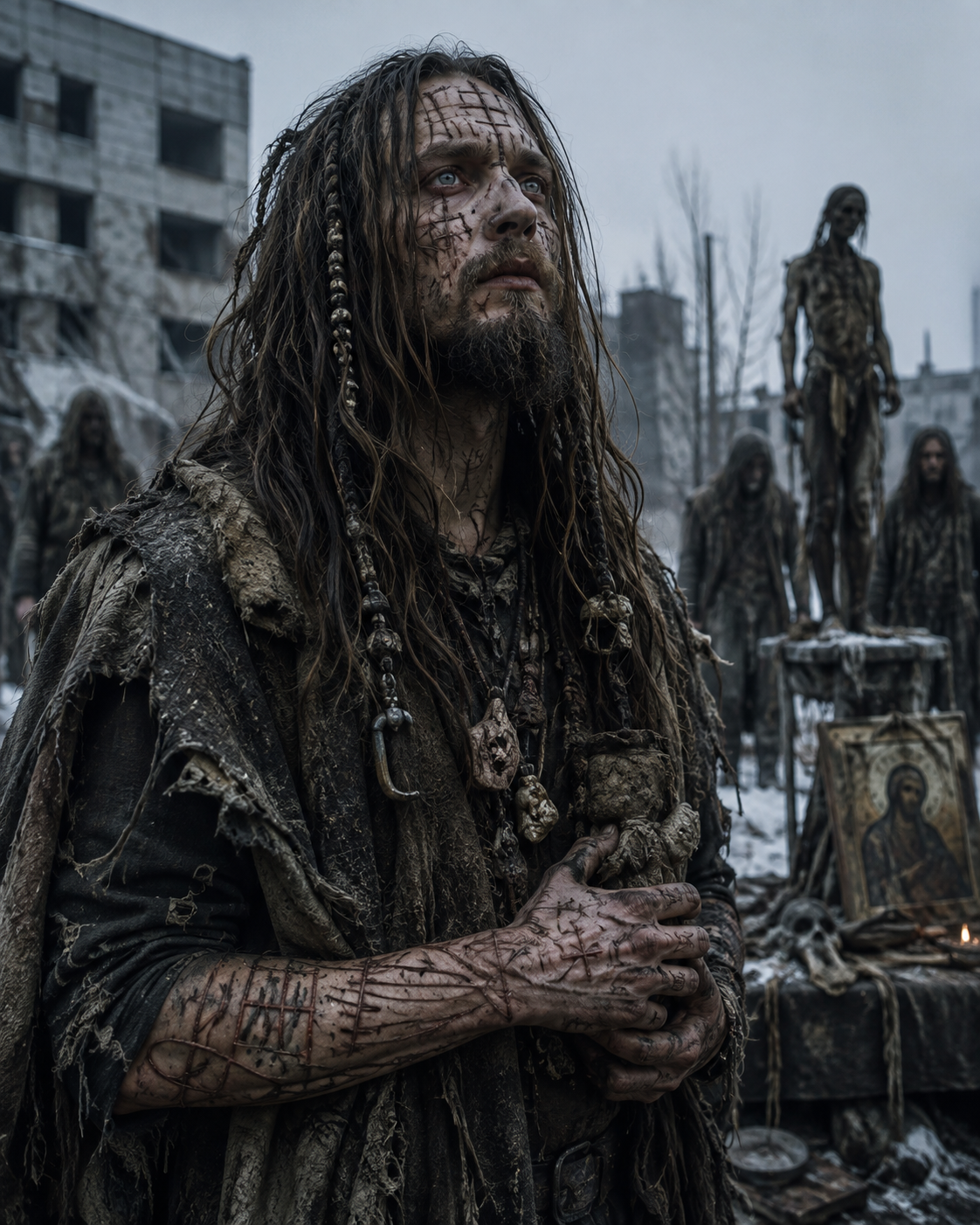
Later historians struggled to classify the Pureborn because they fit poorly into the categories used for most survivor groups. They were not simply raiders, refugees, religious communes, or collaborators with the infected. They were all of those things at different times, but none of those descriptions explained why they could travel beside herds that would tear an ordinary person apart, why their agents repeatedly appeared inside settlements shortly before those settlements were overwhelmed, or why their faith survived long after the voice at the center of it stopped speaking.
To understand the Pureborn, it is necessary to begin with Yuri Mironov.
Mironov was remembered within the faith as the First Listener. He was not called that because he heard a voice inside his own mind, as later stories sometimes claimed. The earliest Pureborn accounts were remarkably consistent on this point: an infected spoke to him. It used a human mouth, formed words, and addressed Yuri while the infected around it left him unharmed.
Whatever was said during that first encounter has been lost beneath generations of retelling. Pureborn writings eventually transformed the moment into scripture, while outside accounts stripped it down until little remained beyond the fact that Yuri survived. What matters historically is what followed. Yuri became the first known uninfected person to maintain repeated contact with the intelligence speaking through the herds, and the intelligence found something in him that the infected themselves could not provide.
Yuri could walk through a human gate.
An infected herd could destroy a settlement, but even a poorly defended community could make that destruction costly. Walls slowed the infected. Barricades forced them into narrow approaches. Armed defenders firing from rooftops and windows could kill dozens or hundreds before the herd broke through. The intelligence controlling them had numbers, but numbers could still be wasted.
Yuri provided another way.
He could speak.
He could lie.
He could be trusted.
The first Pureborn infiltrators rarely looked like the people later generations learned to recognize traveling alongside the herds. When approaching a defended settlement, they hid their brands beneath clothing, removed the bones and teeth they wore among their own people, cleaned themselves when possible, and became whatever the settlement needed them to be. A man who had spent months sleeping beside infected could arrive at a gate as an exhausted refugee. A woman who had helped guide a herd across the countryside could claim that everyone traveling with her had been killed. Others appeared as scavengers, separated soldiers, farmers driven from their land, or survivors carrying rumors about safer territory farther east.
Once inside, they waited.
They learned who controlled the weapons and where ammunition was stored. They watched the changing of guards, counted how many defenders remained awake after midnight, and discovered which gates were opened for scavenging parties or livestock. They listened for arguments between leaders and learned which frightened residents might be persuaded to help them when the time came.
Then they prepared the settlement for the herd.
The method varied because no two settlements were built alike. A gate might simply be left unlatched. A sentry could disappear. A fire might pull defenders away from one side of a wall while infected gathered at another. Vehicles used as barricades were moved just far enough to leave an opening. In larger settlements, several Pureborn sometimes entered separately and lived among the population without acknowledging one another until the night they acted.
The purpose was not conversion alone.
It was the destruction of resistance.
Once the defenses failed, the infected came through.
Some of the people inside were killed during the attack. Others were infected and joined the herds that had destroyed their homes. Those who survived long enough to surrender were gathered afterward, and from that remaining population Yuri and his followers were permitted to recruit.
The Pureborn understood exactly what they were helping to accomplish.
Yuri understood as well.
There is little evidence that he ever considered himself a prisoner of the arrangement. Whatever doubts may have existed early in his relationship with the intelligence disappeared as his faith developed. Yuri came to believe that resistance to the infected was resistance to God himself. A settlement that closed its gates was not merely defending its children or its food stores in his eyes. It was rejecting the order God intended for mankind.
That belief relieved the Pureborn of much of the moral burden an outsider might expect them to carry. Those killed while resisting had chosen defiance. Those infected had been elevated beyond the weaknesses of ordinary humanity. Those left alive had been given an opportunity to understand what others had refused to see.
From this emerged the doctrine of Ascension.
The Pureborn did not consider infection a punishment. It was the completion of human existence. The infected were described in surviving writings as perfected, freed from fear, hesitation, loneliness, and the endless competition that had defined the old world. Individual desire disappeared into something larger, and to the Pureborn this was not the destruction of the person but the end of the divisions that had made humanity weak.
Ascension was therefore desired, but it was not always immediate.
A Pureborn who remained human still had work to perform.
Humans could enter settlements. Humans could build shelters, carry supplies, handle weapons, speak with strangers, scout roads, and understand things the infected could not easily accomplish without revealing themselves. Remaining uninfected was viewed as a period of service. A follower worked for God until that work was complete, and Ascension waited beyond it.
This belief allowed the Pureborn to live beside the infected without envying them to the point of uselessness. It also gave meaning to every hardship. Hunger, cold, isolation, and physical suffering were temporary burdens carried by those not yet called into perfection.
The brand distinguished those servants from everyone else.
Four straight lines inside a circle were burned into the flesh of accepted followers. Placement varied with time and region, though the upper arm, chest, shoulder, and back appear frequently in recovered remains and surviving descriptions. The mark was not hidden when Pureborn lived among their own. It was shown openly and often surrounded by other scars, cuts, or devotional markings.
Its original purpose, however, was not decorative.
The infected recognized it.
A branded follower could walk through a herd while unmarked survivors only meters away would be attacked. Whatever process allowed that recognition proved remarkably durable and became the foundation upon which much of Pureborn life was built. New believers did not need Yuri to explain why they should believe when they could watch a marked man step into a road filled with infected and emerge untouched on the other side.
The Pureborn called the mark protection.
Historians have generally treated it as identification.
The distinction mattered little to those who wore it.
Protected by the brand, the Pureborn stopped living like other survivor communities. Fortified walls were useful when available, but they were not essential. Entire groups moved with large herds across Russia, setting up crude camps when the infected stopped and breaking them down when the mass moved again. Their shelters were made from whatever the landscape surrendered: lumber pulled from abandoned homes, sheets of metal, vehicle panels, canvas, tarps, doors, broken furniture, animal hides, and pieces of military equipment left behind by retreating forces.
Their clothing developed the same way. There was no standard garment and little concern for what had belonged together before the collapse. A military coat might be worn over civilian trousers. Work boots could be bound together with wire. Torn sweaters, camouflage, fur, rain gear, and scavenged uniforms appeared side by side. Clothing was valued because it kept out cold, rain, and wind, not because it displayed rank or wealth.
Decoration came from somewhere else.
Bones and teeth became common among the Pureborn. Animal teeth were threaded onto cord and worn around the neck or wrist. Small bones were bound into long hair with leather, cloth, or wire. Some groups used feathers, carved pieces of antler, fragments of shell, or human teeth recovered from the dead. Hair was commonly left long and tied back in thick knots or braids decorated with whatever the wearer considered meaningful.
To outsiders they often appeared primitive or feral.
That appearance was deceptive.
The Pureborn maintained scouts, food stores, weapons, routes between groups, and systems for carrying information across great distances. They understood herd behavior better than nearly any population that survived outside the UCN bunkers because the herds were not an approaching danger to them.
They were their roads.
When infected moved, Pureborn traveled east with them. When a herd settled around a city or industrial district, followers built camps nearby. They hunted where game remained, scavenged ruined buildings, repaired shelters, and waited until movement resumed. Children born among later Pureborn generations grew up hearing infected outside their sleeping places as an ordinary part of life.
That closeness made infiltration easier.
A settlement watching a herd five kilometers away might never realize that human beings moved within it. Pureborn scouts could leave the herd, change their appearance, conceal their marks, and approach civilization from another direction. By the time the frightened people behind the walls understood that the newcomers belonged to what was gathering outside, the gate might already be open.
Under Yuri Mironov, this system spread across much of Russia.
His followers established small communities wherever the herds carried them and returned with recruits gathered from conquered settlements. Some recruits came because they had watched the Pureborn survive among infected and believed they had witnessed proof of divine protection. Some came because everything they had known had been destroyed and the faith offered structure. Others likely joined because refusal after a settlement had fallen offered few attractive alternatives.
Whatever brought them in, the result was the same.
They were taught.
They were branded.
They became Pureborn.
Yuri's position within this growing faith became unique. Other leaders commanded groups or oversaw camps, but Yuri was the one who had first heard God speak. When infected carrying the voice appeared, Yuri listened. When instructions came, he interpreted them for those around him. His followers began preserving his words, repeating his teachings around fires, and carrying versions of them from one herd to another.
The intelligence encouraged the relationship. Yuri's success fed its own view of itself, and the adoration of thousands appears to have done little to temper an already overwhelming narcissism. What began as a useful human intermediary became something more. It had followers who knelt when it spoke through an infected body, people who carved their devotion into their own flesh, and servants willing to betray entire settlements because they believed its will stood above ordinary human life.
Yuri had found God.
God had found worship.
The arrangement endured beyond Yuri himself.
The circumstances of Yuri Mironov's final years remain disputed even among surviving Pureborn traditions. Some accounts place him with the eastern herds, while others claim he withdrew from ordinary leadership and spent his final period moving between several important congregations. What is known is that the Pureborn did not collapse when the First Listener was no longer able to lead them.
They created a way to continue without him.
The leaders who followed Yuri retained the title Listener.
Unlike Yuri, they did not necessarily claim that an infected had spoken directly to them. Direct speech from God remained something sacred and unpredictable, and no later Listener could simply declare himself equal to the man who had first heard it. Instead, the Pureborn selected Listeners from among respected elders, herd leaders, infiltrators, and teachers who were believed capable of understanding God's will when no spoken command was given.
Selection varied between congregations, but several traditions appear repeatedly in recovered accounts. Candidates were expected to have lived among the herds for many years, to have successfully brought survivors into the faith, and to know the teachings attributed to Yuri. Some communities chose by agreement among senior followers. Others required candidates to walk alone through a large herd and return unharmed before being considered.
The office gave the scattered faith a measure of continuity.
Listeners settled disputes, decided when groups should follow or leave a herd, selected infiltrators, approved branding, and interpreted unusual infected behavior. When direct words came through an infected, those words remained absolute. When they did not, the Listener was expected to determine what God required through observation and the teachings passed down from Yuri.
For generations, this was enough.
Then came the period Pureborn records later called the Time of Quiet.
No universally accepted date marks its beginning. The change appears to have been noticed gradually across different groups. Infected still moved. Herds still gathered and separated. The branded remained able to pass among them.
But the voice stopped.
No infected stepped forward to deliver commands.
No mouth among the herds spoke with the authority Yuri had once known.
At first the Pureborn waited.
Some believed the silence was a test. Others taught that God had withdrawn because the faithful had become too dependent upon hearing him and needed to prove that they understood his teachings without constant instruction. A few surviving fragments suggest fear spread among some congregations, but the larger faith did not dissolve.
The Listeners prevented that.
They taught that silence was not absence.
The herds remained.
The brand remained.
The infected still recognized the faithful.
For the Pureborn, those facts mattered more than the lack of words.
During the Time of Quiet, the office of Listener became more important than it had ever been under Yuri. Without direct commands, Listeners relied on movement, patterns, old teachings, and inherited doctrine. If a herd suddenly changed direction, the Listener decided whether it carried meaning. If infected gathered around a particular place, the congregation considered whether God was directing them there. If a settlement appeared along the route, the old practices of infiltration and preparation continued whether a voice had ordered it or not.
Different interpretations inevitably developed.
Some Listeners emphasized Ascension and encouraged followers to remain close to infected wherever possible. Others focused on infiltration and the destruction of settlements that resisted the new world. Certain groups became more ritualistic, adding new scar patterns, prayers, and ceremonies around branding. Others remained comparatively practical and treated the teachings of Yuri almost as military instructions for surviving beside the herds.
They disagreed about many things.
They never abandoned the mark.
They never abandoned Ascension.
And they never accepted that the silence meant God was gone.
To them, the Time of Quiet was simply another age of the faith.
God had spoken through Yuri Mironov.
Yuri had taught the first followers.
The Listeners carried those teachings after him.
And as long as the infected still stepped aside when they saw four straight lines inside a circle, the Pureborn saw no reason to believe their covenant had ended.